

28 Sep After-Hours Security for Houston Businesses: A Practical Closing-Time Checklist
Why closing time deserves a security plan
A business can look orderly during the day and operate very differently after employees leave. Entrances become quieter, deliveries may continue, cleaning crews arrive, and fewer people are available to notice a problem. For Houston business owners and property managers, after-hours security starts with understanding those changes. A practical plan identifies who should be on the property, which areas need attention, and how concerns reach the right person. The goal is a consistent routine that supports people and operations, rather than relying on assumptions that someone else checked the building.
Start with a walkthrough at the right time
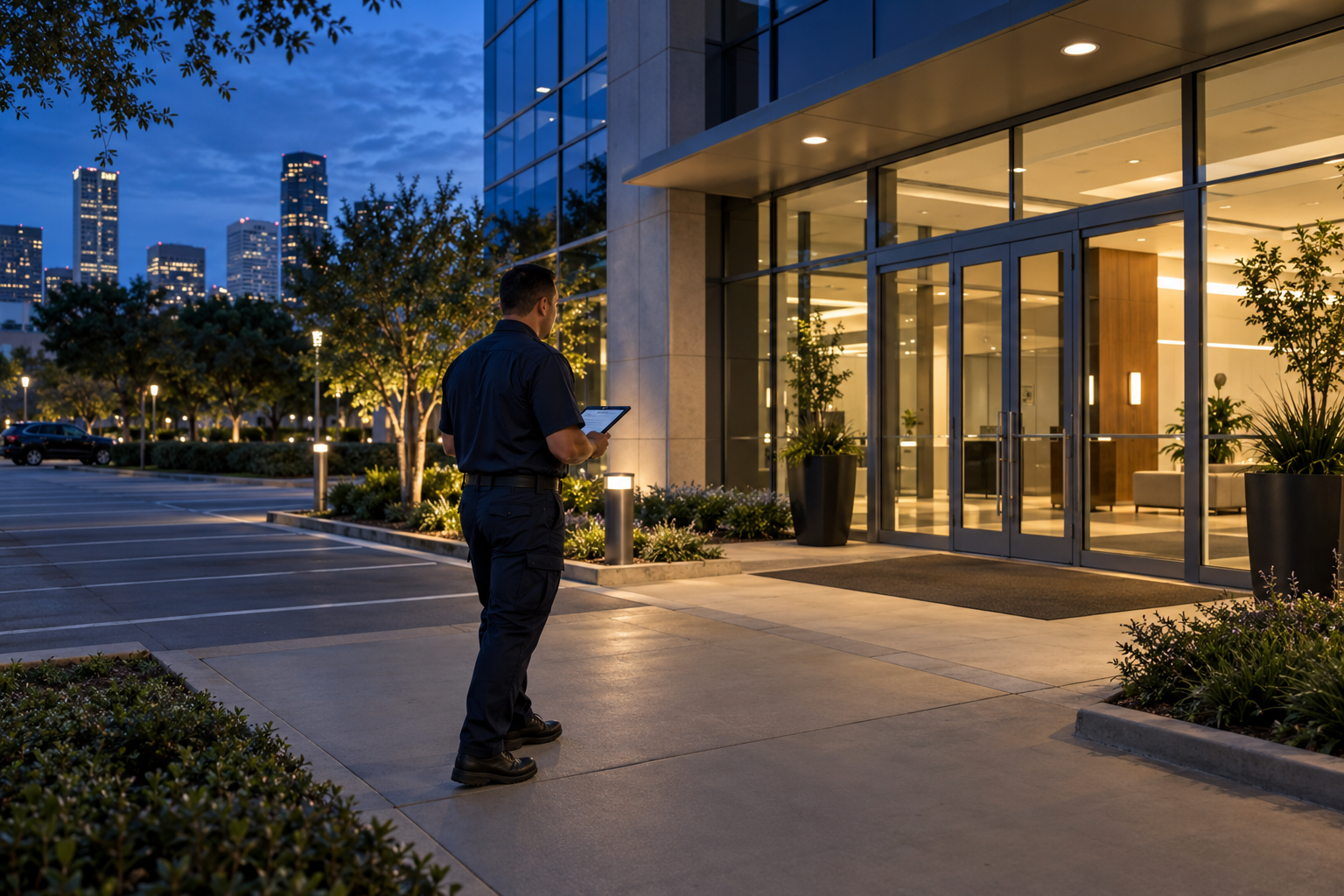
Review the property near closing and again after normal activity ends. Look at entrances, parking areas, loading zones, shared corridors, and the paths employees use to reach their vehicles. Note lighting that needs attention, doors that do not close properly, and landscaping or stored materials that limit visibility. A daytime inspection can miss conditions that appear after dark. Record maintenance concerns and assign responsibility for follow-up. Security personnel can report observations, while authorized property staff arrange repairs. Repeat the walkthrough when operating hours, tenant activity, or the physical layout changes.
Write a clear closing checklist
A useful closing checklist tells designated staff what to inspect and how to report an exception. Include approved door checks, visitor sign-out, delivery-area review, and confirmation that access points are operating as intended. Identify who handles alarm procedures and who receives a report when something is unusual. Keep the checklist short enough to use consistently. Staff should not enter an unfamiliar or unsafe area simply to complete a task. Instead, the plan should explain when to stop, move to a safe location, and contact the appropriate supervisor or emergency service.
Account for everyone authorized to enter
After-hours access is not limited to employees. Cleaning teams, maintenance vendors, contractors, and delivery personnel may have legitimate reasons to arrive when the office is closed. Maintain an authorized-access process that identifies expected visitors and provides a way to verify unexpected arrivals. Give vendors clear instructions about entrances, work areas, and departure procedures. Avoid relying on a uniform, vehicle logo, or familiar face alone. When authorization cannot be confirmed, personnel should follow the property’s procedures rather than improvise. Access records should be handled according to the organization’s privacy and retention policies.
Match coverage to the property’s needs
Some sites benefit from a stationary security presence at a lobby or gate. Others may need scheduled checks across several buildings or attention to parking and perimeter areas. Consider activity patterns, the size of the property, occupied areas, and the responsibilities that require continuous coverage. A patrol visit and a continuously staffed post serve different purposes. Discuss the actual assignment with a security provider, including hours, reporting expectations, access arrangements, and escalation procedures. Selecting coverage should follow the property’s operational needs; the presence of a guard alone does not replace working locks, lighting, or staff procedures.
Coordinate security with building systems
Security personnel, cameras, alarms, and access-control systems are most useful when their roles connect. Clarify who monitors an alert, who can review footage, and who may authorize access or a system change. Report faulty equipment promptly and explain the temporary procedure while it awaits repair. Do not assume a camera is recording or an alarm is monitored without confirming the arrangements with the responsible provider. Keep operating instructions available to authorized personnel. The security plan should also describe how staff communicate if normal equipment or connectivity becomes unavailable during an assignment.
Create a communication and escalation list
An after-hours incident can become harder to manage when nobody knows whom to call. Maintain a current list of authorized contacts, including property management, tenant representatives when applicable, and relevant maintenance providers. Define the situations that need immediate attention and those that can be documented for the next business day. Personnel should follow their training and assignment instructions; urgent threats to life or safety call for emergency services. Test the contact process periodically and identify a backup contact. A list that contains disconnected numbers or unavailable decision-makers provides little practical support.
Protect the employee departure routine
Closing procedures should include the people who leave last. Consider the route between the workplace and parking areas, the availability of lighting, and how employees request help if they notice a concern. Where appropriate, establish an approved departure or escort procedure suited to the site and the personnel available. Employees should know where to wait and how to contact the designated person. Avoid promising that any particular procedure eliminates risk. The purpose is to give staff a clear, supported process and a way to report conditions that need review.
Use reports to improve the next shift
Good reporting turns an isolated observation into something management can act on. Record the time, location, relevant observations, notifications made, and the steps taken under the assignment. Separate what personnel observed from assumptions about someone’s intent. Repeated reports of a propped door, late vendor arrival, or lighting problem may reveal a procedure that needs adjustment. Share relevant information during shift handoffs without circulating unnecessary personal details. Management should review recurring concerns and document corrective actions. Reporting matters most when someone owns the follow-up and checks whether the problem was resolved.
Review the plan before the next busy period
An after-hours security plan should evolve with the business. Revisit it when staffing, opening hours, deliveries, construction, or tenant needs change. Ask employees which closing tasks are unclear and which contact arrangements are difficult to use. Walk the site again after repairs or layout changes. For help reviewing your property’s security needs, contact Decca Security to discuss the location, operating schedule, and coverage requirements. A clear conversation about the assignment can help establish practical expectations for closing time, overnight activity, and the handoff to the next business day. Before the discussion, gather current hours, entrance information, vendor schedules, and recent operational concerns. These details give the provider a useful starting point and help property managers explain what reliable coverage should accomplish.